



Ένα κατάστημα, δύο αποθέματα: Τέλος στον διαχωρισμό φυσικού και ηλεκτρονικού καταστήματος
Τα περισσότερα καταστήματα που πουλούν αυτοπροσώπως και ηλεκτρονικά διατηρούν δύο αποθέματα που συνδέονται με μια εφαρμογή συγχρονισμού, και αυτό το κενό είναι η αιτία για τις υπερπωλήσεις, τα λανθασμένα αποθέματα και τις απογραφές της Κυριακής το βράδυ. Δείτε πώς τελειώνει πραγματικά αυτός ο διαχωρισμός.
 Mathias NielsenCEO, Final POS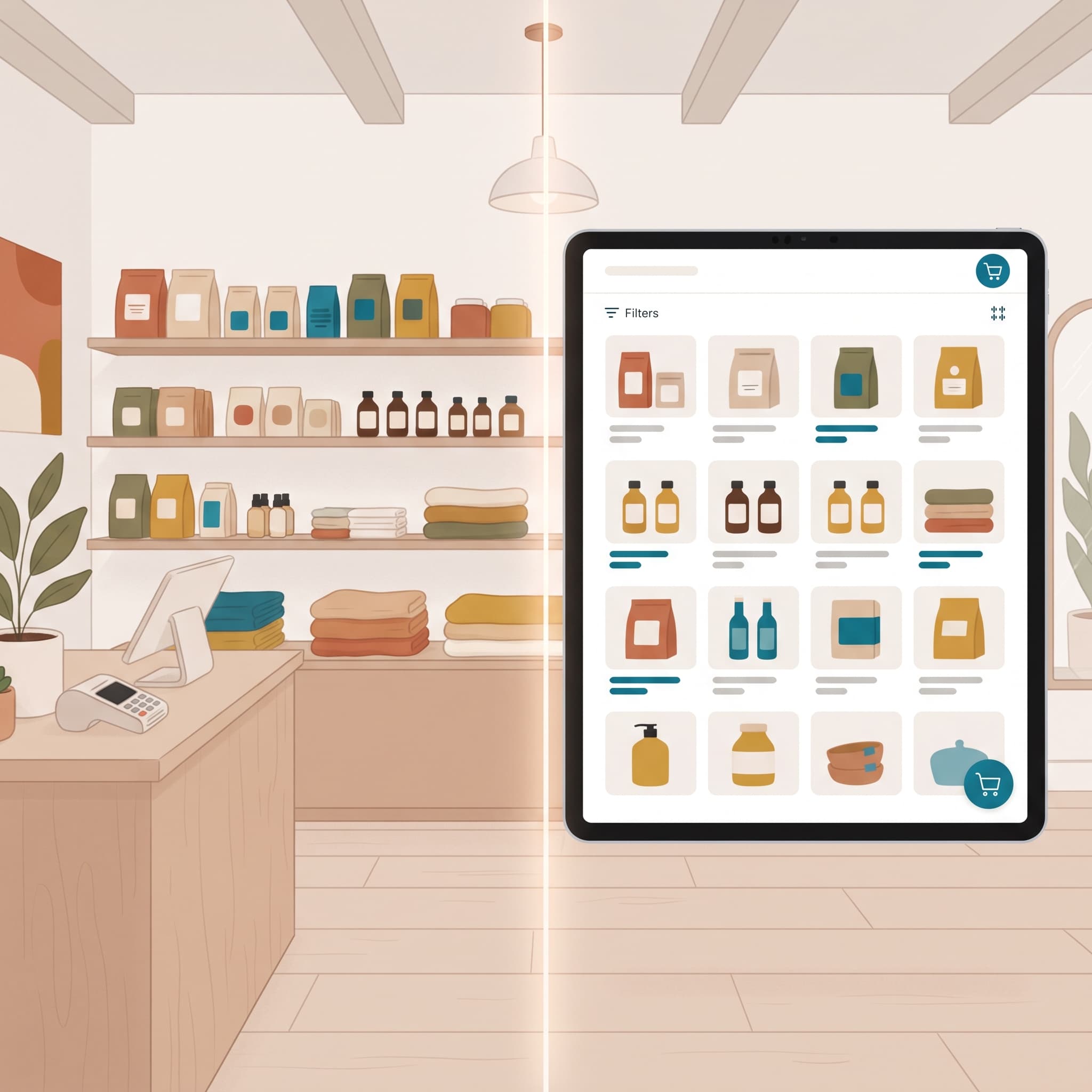
A store that sells in person and online usually isn't running one inventory. It's running two inventories that exchange letters: the shelf count lives in the POS, the online count lives in the e-commerce platform, and a sync connector shuttles updates between them. Every oversell, every "sorry, we don't actually have that" email, and every Sunday-night recount comes out of that gap. The fix isn't a better connector. It's one inventory record that every channel reads and writes.

Why do in-store and online counts drift apart?
Counts drift because two systems each keep their own ledger of the same shelf. When someone buys at the register, the POS decrements its copy. When someone buys online, the e-commerce platform decrements its copy. A connector then carries each change to the other side, sometimes in seconds, sometimes in a batch job that runs every fifteen minutes.
Between the sale and the copy, both systems believe the item is still in stock. That window is small, but it isn't the only leak. Refunds and exchanges often post to one side and not the other. A renamed product or edited variant can quietly break the SKU mapping (a SKU is the ID for one sellable item; more terms in our POS terminology guide), after which the two systems aren't even talking about the same product. Connector outages tend to fail silently: nothing errors, the counts just stop agreeing.
Drift compounds. Each small mismatch survives until someone physically recounts the shelf, and by then nobody knows which system was right.
What does the split actually cost?
Globally, out-of-stocks and overstocks cost retail an estimated $1.73 trillion a year, about 6.5% of sales¹. For a single store, the split shows up in four smaller, steadier bills.
Buffered stock: showing 3 online when you have 5, so a sync lag can't oversell. That's inventory you paid for but won't let anyone buy.
Reconciliation time (checking that the two counts agree): hours of staff time spent recounting shelves and correcting whichever system lost.
Oversell cleanup: refunds, apology emails, and the occasional one-star review when the "in stock" item wasn't.
The sync stack itself: the connector or e-commerce sync tier is usually one of the line items in the hidden SaaS bill retailers carry.
None of these appear on a P&L as "inventory split," which is why the split survives.

Can't a sync app just fix it?
For some stores, a connector is fine, and it's worth saying so plainly. If your turnover is slow, you rarely hold the last unit of anything, and you run one location, a decent sync will hold up most of the time. Take the workaround if that's you.
It stops holding up under exactly the conditions you're hoping to reach. High traffic shrinks the odds that a sync window passes without two channels touching the same item. Scarce or one-of-a-kind stock (vintage, consignment, small-batch) makes every unit a last unit. Multiple outlets multiply the mappings that can silently break. A sync app manages the symptom well enough at low volume; the two ledgers underneath are still the disease.
What does one inventory actually mean?
It means a single source of record (one database everyone trusts) instead of two ledgers and a courier. The counter, the online storefront, and any kiosk read the same count and write their sales to the same record at the moment the sale commits. When two channels grab the last unit at the same instant, the ledger itself resolves who got it; there is no "later" in which a sync job discovers the conflict. The catalog is shared the same way: one product, one price, one tax rule, every channel.
That architecture is hard to retrofit. Two mature systems joined by an integration will always have two ledgers, because each was built assuming it owned the count. It has to be how the platform works from the start, which is how Final treats it: the online store and the register are two views of one record, so the gap never opens. Real-time visibility is also the foundation everything else in POS inventory management builds on. Reorder points and stock alerts are only as good as the count they read, and retailers get the efficiency gains only after the count is trustworthy.
So, can you end the in-store/online split?
Yes, but not by syncing harder. The split is a property of running two systems, and it ends when both channels run on one ledger, not when the copying between ledgers gets faster. If you're evaluating platforms, a useful test: ask where the online order and the counter sale are recorded, and whether that's the same place. (Choosing a retail POS involves more than inventory, but this question filters fast.)
Rule of thumb: if your register and your online store can disagree about the same shelf, you have two inventories, whatever the sync app promises.
Συχνές ερωτήσεις
Γιατί δεν συμφωνούν οι καταμετρήσεις αποθέματος του φυσικού και του ηλεκτρονικού μου καταστήματος;
Επειδή κάθε σύστημα διατηρεί το δικό του καθολικό και ένα εργαλείο συγχρονισμού αντιγράφει τις αλλαγές μεταξύ τους με καθυστέρηση. Οι πωλήσεις, οι επιστροφές χρημάτων, οι ανταλλαγές και οι επεξεργασίες καταλόγου που πραγματοποιούνται κατά τη διάρκεια αυτής της καθυστέρησης (ή αποτυγχάνουν να αντιστοιχιστούν) συσσωρεύονται ως αποκλίσεις.
Θα σταματήσει τις υπερπωλήσεις μια καλύτερη εφαρμογή συγχρονισμού;
Θα τα καταστήσει πιο σπάνια, όχι αδύνατα. Κάθε συγχρονισμός έχει ένα χρονικό παράθυρο μεταξύ μιας πώλησης και της στιγμής που το αντίγραφο φτάνει στο άλλο σύστημα, και οι στιγμές με τη μεγαλύτερη κίνηση είναι ακριβώς εκείνες που δύο κανάλια είναι πιο πιθανό να πουλήσουν την τελευταία μονάδα μέσα σε αυτό το παράθυρο.
Τι είναι η ενιαία πηγή καταγραφής για το απόθεμα;
Μία βάση δεδομένων από την οποία κάθε κανάλι πωλήσεων διαβάζει και στην οποία γράφει τη στιγμή της πώλησης (ένα σύστημα καταγραφής). Το ταμείο, το ηλεκτρονικό κατάστημα και κάθε kiosk μειώνουν όλα τον ίδιο αριθμό, επομένως δεν υπάρχει δεύτερο αντίγραφο που να αποκλίνει.
Χρειάζομαι ξεχωριστές μετρήσεις αποθέματος για να πουλάω online και αυτοπροσώπως;
Όχι. Εάν η πλατφόρμα σας εκτελεί και τα δύο κανάλια με βάση ένα καθολικό, μία μέτρηση εξυπηρετεί και τα δύο. Οι ξεχωριστές μετρήσεις και τα δεσμευμένα αποθέματα ασφαλείας για «online απόθεμα» είναι προσωρινές λύσεις για συστήματα που δεν μπορούν να μοιραστούν ένα καθολικό.