



Un singur magazin, două inventare: Eliminarea separării dintre fizic și online
Majoritatea magazinelor care vând fizic și online rulează două inventare conectate printr-o aplicație de sincronizare, iar acel decalaj este sursa vânzărilor în exces, a stocurilor eronate și a inventarierilor de duminică seara. Iată cum se termină de fapt această separare.
 Mathias NielsenCEO, Final POS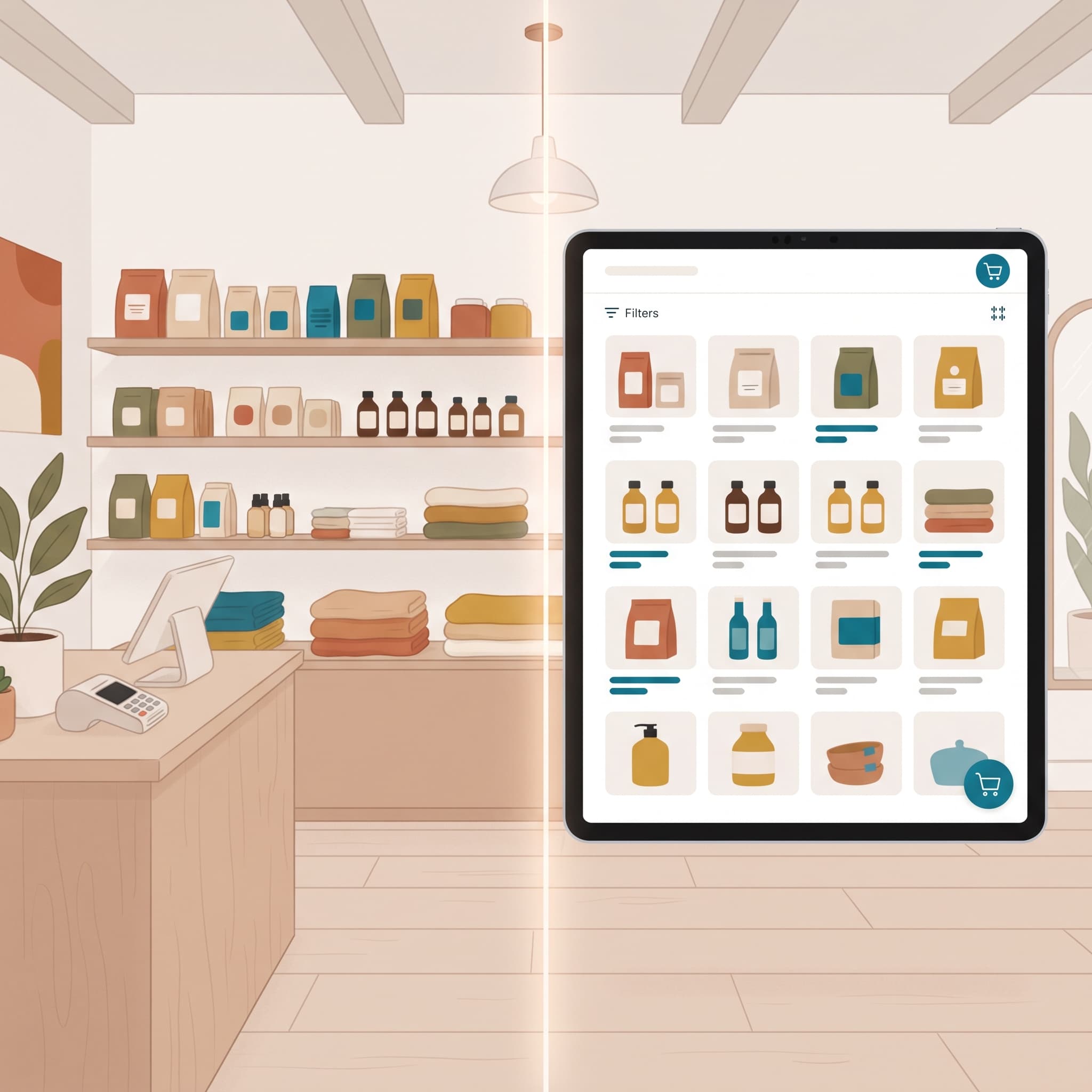
A store that sells in person and online usually isn't running one inventory. It's running two inventories that exchange letters: the shelf count lives in the POS, the online count lives in the e-commerce platform, and a sync connector shuttles updates between them. Every oversell, every "sorry, we don't actually have that" email, and every Sunday-night recount comes out of that gap. The fix isn't a better connector. It's one inventory record that every channel reads and writes.

Why do in-store and online counts drift apart?
Counts drift because two systems each keep their own ledger of the same shelf. When someone buys at the register, the POS decrements its copy. When someone buys online, the e-commerce platform decrements its copy. A connector then carries each change to the other side, sometimes in seconds, sometimes in a batch job that runs every fifteen minutes.
Between the sale and the copy, both systems believe the item is still in stock. That window is small, but it isn't the only leak. Refunds and exchanges often post to one side and not the other. A renamed product or edited variant can quietly break the SKU mapping (a SKU is the ID for one sellable item; more terms in our POS terminology guide), after which the two systems aren't even talking about the same product. Connector outages tend to fail silently: nothing errors, the counts just stop agreeing.
Drift compounds. Each small mismatch survives until someone physically recounts the shelf, and by then nobody knows which system was right.
What does the split actually cost?
Globally, out-of-stocks and overstocks cost retail an estimated $1.73 trillion a year, about 6.5% of sales¹. For a single store, the split shows up in four smaller, steadier bills.
Buffered stock: showing 3 online when you have 5, so a sync lag can't oversell. That's inventory you paid for but won't let anyone buy.
Reconciliation time (checking that the two counts agree): hours of staff time spent recounting shelves and correcting whichever system lost.
Oversell cleanup: refunds, apology emails, and the occasional one-star review when the "in stock" item wasn't.
The sync stack itself: the connector or e-commerce sync tier is usually one of the line items in the hidden SaaS bill retailers carry.
None of these appear on a P&L as "inventory split," which is why the split survives.

Can't a sync app just fix it?
For some stores, a connector is fine, and it's worth saying so plainly. If your turnover is slow, you rarely hold the last unit of anything, and you run one location, a decent sync will hold up most of the time. Take the workaround if that's you.
It stops holding up under exactly the conditions you're hoping to reach. High traffic shrinks the odds that a sync window passes without two channels touching the same item. Scarce or one-of-a-kind stock (vintage, consignment, small-batch) makes every unit a last unit. Multiple outlets multiply the mappings that can silently break. A sync app manages the symptom well enough at low volume; the two ledgers underneath are still the disease.
What does one inventory actually mean?
It means a single source of record (one database everyone trusts) instead of two ledgers and a courier. The counter, the online storefront, and any kiosk read the same count and write their sales to the same record at the moment the sale commits. When two channels grab the last unit at the same instant, the ledger itself resolves who got it; there is no "later" in which a sync job discovers the conflict. The catalog is shared the same way: one product, one price, one tax rule, every channel.
That architecture is hard to retrofit. Two mature systems joined by an integration will always have two ledgers, because each was built assuming it owned the count. It has to be how the platform works from the start, which is how Final treats it: the online store and the register are two views of one record, so the gap never opens. Real-time visibility is also the foundation everything else in POS inventory management builds on. Reorder points and stock alerts are only as good as the count they read, and retailers get the efficiency gains only after the count is trustworthy.
So, can you end the in-store/online split?
Yes, but not by syncing harder. The split is a property of running two systems, and it ends when both channels run on one ledger, not when the copying between ledgers gets faster. If you're evaluating platforms, a useful test: ask where the online order and the counter sale are recorded, and whether that's the same place. (Choosing a retail POS involves more than inventory, but this question filters fast.)
Rule of thumb: if your register and your online store can disagree about the same shelf, you have two inventories, whatever the sync app promises.
Întrebări frecvente
De ce nu corespund stocurile din magazinul fizic cu cele din magazinul online?
Deoarece fiecare sistem își menține propriul registru, iar un instrument de sincronizare copiază modificările între ele cu o anumită întârziere. Vânzările, rambursările, schimburile și modificările de catalog care au loc în timpul acelei întârzieri (sau care nu reușesc să se coreleze) se acumulează ca discrepanțe.
Va opri supra-vânzările o aplicație de sincronizare mai bună?
Le va face mai rare, nu imposibile. Orice sincronizare are un interval de timp între o vânzare și momentul în care copia ajunge în celălalt sistem, iar cele mai aglomerate momente sunt exact cele în care două canale au cele mai mari șanse de a vinde ultima unitate în acel interval.
Ce este o sursă unică de referință pentru stocuri?
O singură bază de date din care fiecare canal de vânzare citește și în care scrie în momentul vânzării (un sistem de referință). Casa de marcat, magazinul online și orice kiosk scad din același stoc, astfel încât nu există o a doua copie care să se desincronizeze.
Am nevoie de stocuri separate pentru vânzarea online și cea în persoană?
Nu. Dacă platforma ta rulează ambele canale pe baza unui singur registru, un singur stoc este suficient pentru ambele. Stocurile separate și rezervele de „stoc online” sunt soluții de compromis pentru sistemele care nu pot partaja un registru comun.